Why the question keeps coming up
You take a few photos of the car for a marketplace listing, scroll back through them, and notice the plate is perfectly readable in every shot. The instinct to pause and think about that is healthy. It's also why "what can someone actually do with my plate number" is one of the most searched privacy questions for sellers in 2026.
The honest answer has two halves that often get collapsed together. On one side, a plate on its own is not a master key. It does not unlock your bank account, your email, or your DMV file. On the other side, a plate is an unusually clean, standardized identifier attached to a specific vehicle and ultimately to a specific person, which makes it unusually useful to anyone who already has a reason to look.
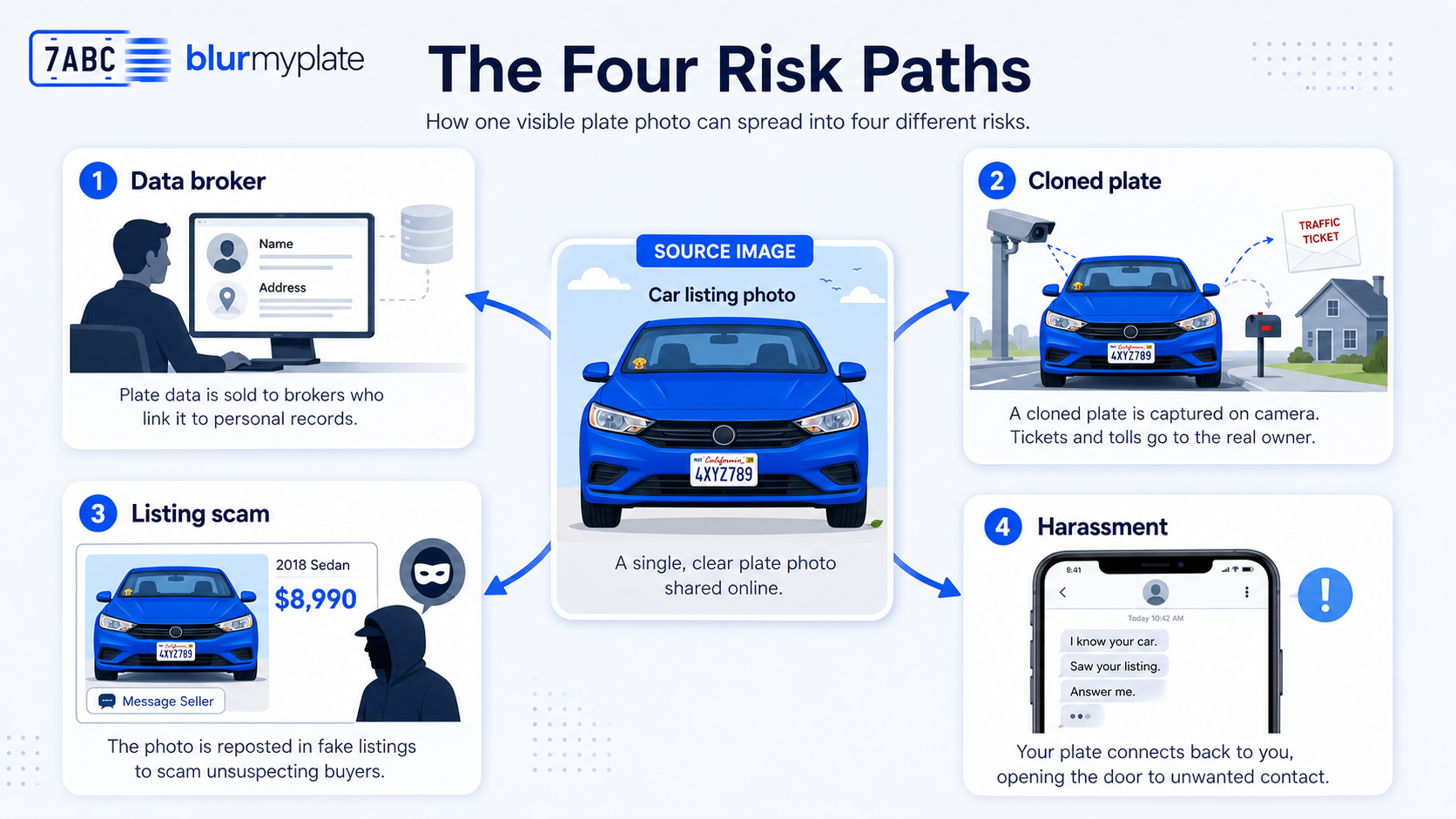
The risk lives in the pairing. A passing driver who glances at your plate in traffic gets a fleeting look. A scraper, scammer, or aggrieved stranger who finds a clean photo of your plate in a public listing gets a static, searchable identifier they can save, paste into a paid lookup, repost into a fake ad, or match with other things they already know about you.
A plate on the road is one detail among many. A plate in a listing is a permanent, shareable identifier sitting next to your photos, location, and seller profile.
What someone realistically can do
Find your name and current address through a data broker
In the US, the DMV will not hand your details to a random member of the public. The federal Driver's Privacy Protection Act (DPPA) restricts disclosure of motor-vehicle records to a closed list of permitted purposes (law enforcement, insurance, certain civil matters). That part of the system mostly works.
The unprotected layer sits next to it. Paid people-search and skip-trace data brokers aggregate public records, voter rolls, court filings, marketing lists, and historical driving data, then sell the merged profile back to anyone with a credit card. A clear plate number combined with a name, neighborhood, or seller profile gives that lookup a strong anchor.
The practical translation: a stranger probably can't go from "I saw your plate" to "I know where you live" in one click, but a stranger who is already mildly motivated can often close that gap with a $20 broker subscription and a few minutes of searching.
Clone your plate onto a similar car
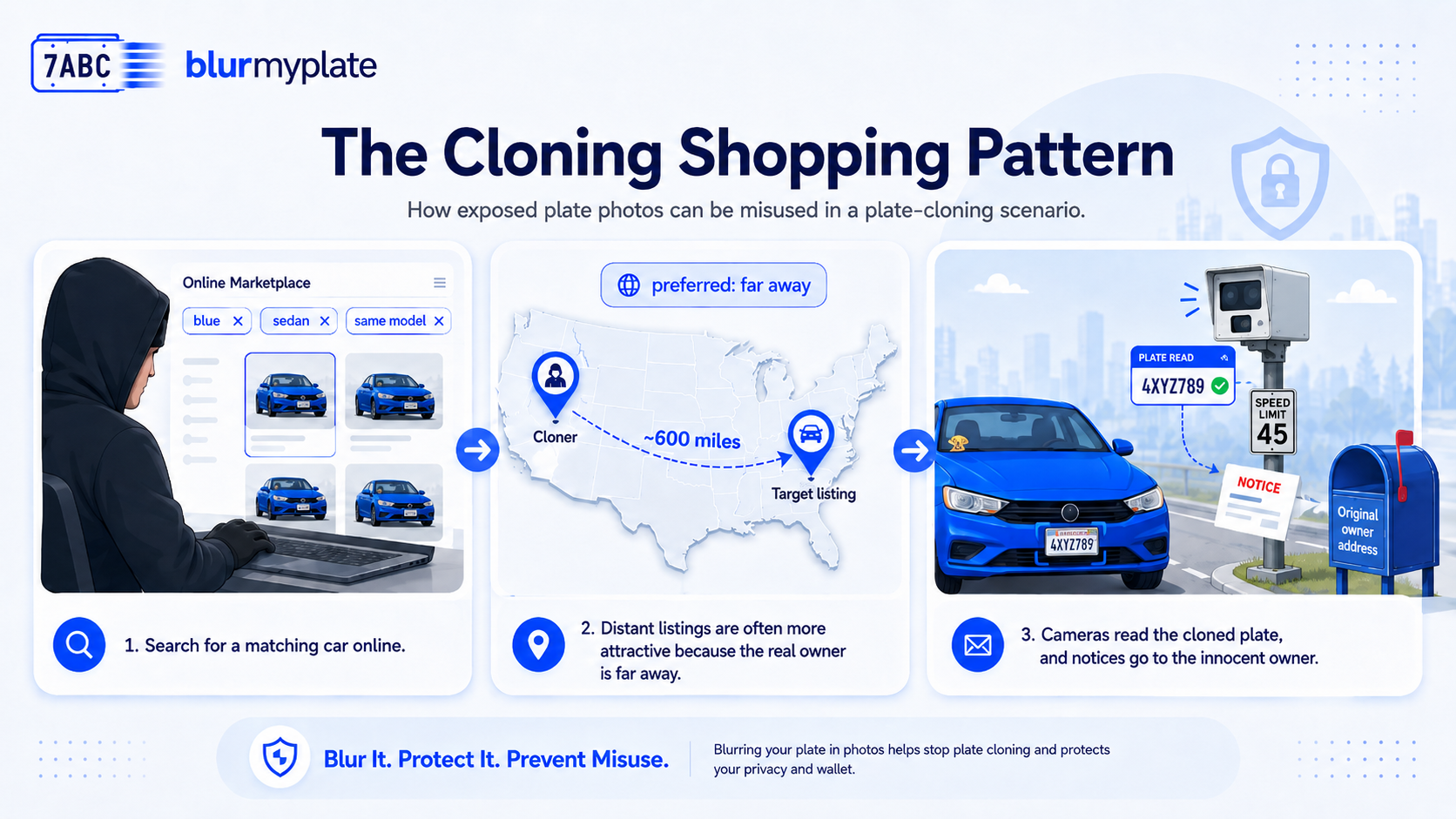
Plate cloning is the criminal version of impersonation. Someone copies your visible plate number onto a fake plate, fits it to a car of the same make and color, and drives that car through parking lots, toll gantries, and speed cameras. Their tickets, tolls, and traffic violations then get mailed to you, because the cameras read your number.
The selection isn't random. Police and fleet-security advisories describe a deliberate shopping pattern: cloners scan public photos for vehicles that match their own car's make, model, and color, and prefer matches geographically distant from where they operate so the real owner never spots the duplicate at a supermarket or service station. A clear listing photo gives them everything they need in one place — plate, make, model, paint, sometimes trim and region — without ever leaving home. That's why marketplace, forum, and dealer-inventory photos are the easiest hunting ground.
Once a cloned plate is on the road, every automated reader — speed cameras, red-light cameras, toll gantries, parking-enforcement scanners — logs the number, which is yours, not the cloned car's VIN. The legal cleanup falls on the innocent owner, and untangling it with the DMV, a toll authority, a municipal court, or a parking contractor can take months.
Use your photos in a listing scam
Listing-scam mechanics are well-documented across Facebook Marketplace, Craigslist, OfferUp, and forum classifieds. A scammer screenshots your for-sale photos, reposts them on another platform at a lower price, and collects deposits or wire transfers on a car that was never theirs. A visible plate adds credibility, because the photos look tied to an identifiable, real-world vehicle rather than a stock image.
The cost to you is reputational and procedural. Buyers contact you about a car you already sold or never listed at that price. You spend hours explaining the situation, reporting the fake listing, and sometimes coordinating with the platform's trust-and-safety team. The original photo, with your plate still in it, often keeps circulating.
Use it as one more identifier for offline follow-up
The least common but most uncomfortable scenario is targeted: someone who already has a reason to focus on you uses a visible plate to connect a car to a routine, a parking spot, a workplace, or a residence. This is rare, but it is the one users tend to worry about most, and it is the one a blurred plate most directly defuses.
Send harassment to the wrong person
A visible plate also exposes you to a more arbitrary risk: misdirected internet outrage. Dashcam clips, hit-and-run posts, parking-lot incidents, and viral "this driver did X" social posts often include a clear plate. Strangers run it through a lookup service, arrive at the registered owner, and start the harassment campaign there — even when the actual driver was a friend, a teenager, a rental tenant, or an entirely different car with cloned plates. Blurring the plate before you publish your own car photos isn't only about your behavior; it's about not getting pulled into someone else's mistaken-identity pile-on.
You don't need to assume a worst-case scenario for blurring to make sense. The cost of blurring is zero. The cost of being the unlucky one if you don't is uncapped.
What a plate number alone can't do
A useful privacy answer has to be honest in both directions, because exaggeration trains readers to ignore the real risks too. Here is what a plate number, on its own, will not do.
- Pull your full DMV record. Under the DPPA, obtaining motor-vehicle records for most purposes is restricted. A plate is not an open door to your driving history, registration documents, or vehicle title.
- Unlock your accounts. A plate number isn't a password, a Social Security number, or a verification factor. On its own it can't drain a bank account, reset an email login, or bypass two-factor authentication.
- Identify a stranger instantly and for free. Without either a broker subscription, an existing data point about the owner, or a photo that ties the plate to a person, a number plate seen in isolation is just a number.
- Reveal your real-time location. Plates aren't GPS trackers. Real-time tracking requires either a physical device or repeated camera sightings, neither of which a public photo provides on its own.
The point of this section is not to deflate the concern. It's to keep the conversation calibrated. The risks above (broker lookup, cloning, scam reuse, targeted follow-up) are real and worth defusing. The risks here are not, and pretending otherwise just burns trust.
Why a listing photo outlives the listing
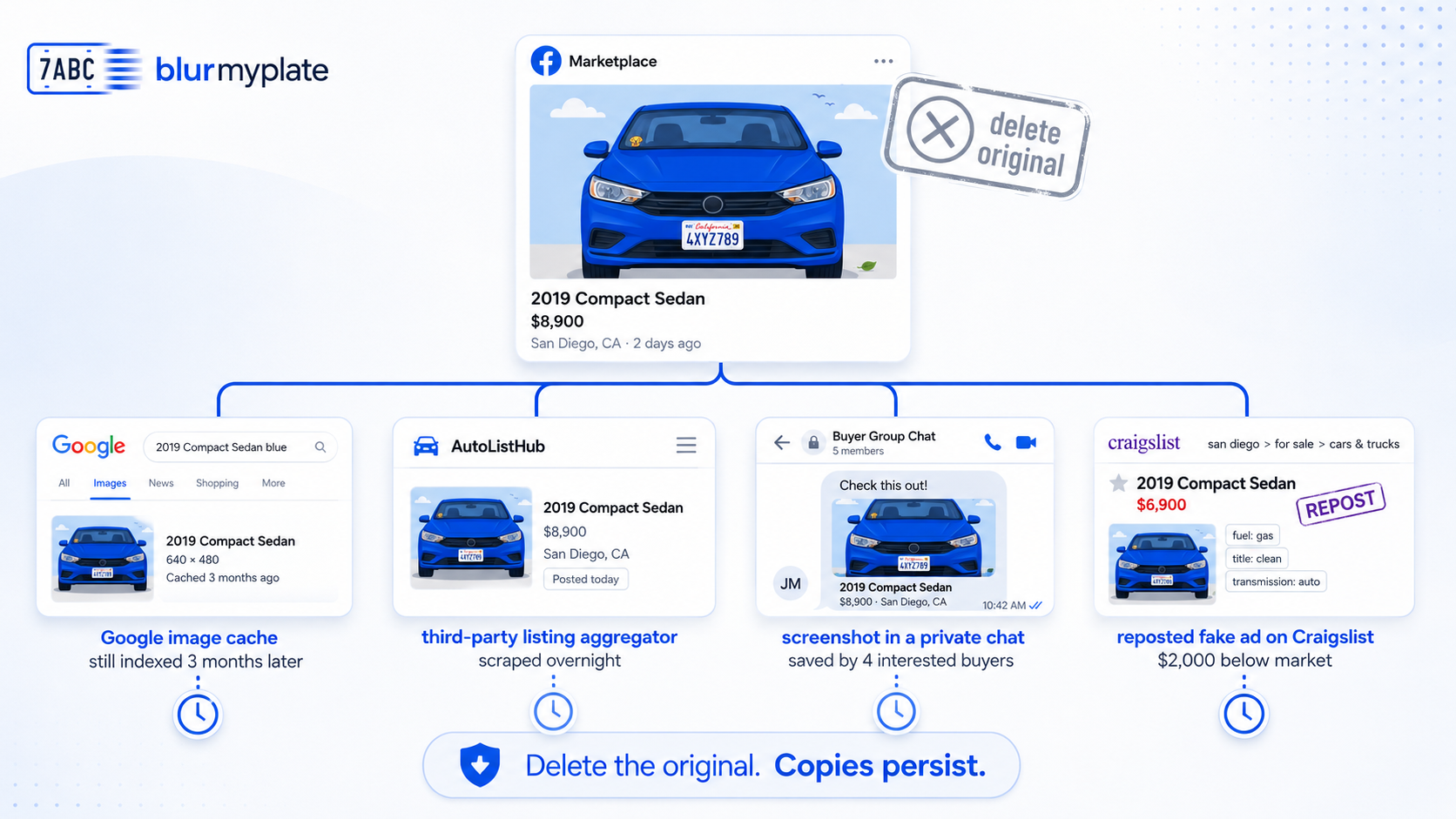
The reason "just delete the listing when the car sells" is not a real privacy strategy: once a photo is public, the original upload is rarely the only copy.
- Search engines and previews keep caches. Image search, social-card previews, and archive sites can keep a copy reachable for weeks or months after the source listing is gone, sometimes longer.
- Marketplace listings get scraped. Listings on Facebook Marketplace, Craigslist, OfferUp, Autotrader, and Cars.com routinely flow into third-party aggregators, dealer-feed scrapers, and overseas reposting tools you never agreed to.
- Screenshots travel without context. Once an interested viewer screenshots the listing (for memory, comparison, or sharing with a partner), the photo is now living somewhere you no longer control.
- Profile and pickup details often appear alongside. The same listing that shows the plate often shows neighborhood, profile name, and asking price. A stranger doesn't need to do detective work; the bundle is right there.
Blurring at upload time is the only step in this chain you actually control. Every downstream copy inherits the blurred version. Every downstream copy of an unblurred photo inherits the plate.
Outside the US: UK, Canada, Australia
The same search lands here from outside the US, where the term is usually "number plate" and the legal framework around owner lookups is different. The exposure mechanics (cloning, brokers, listing scams, screenshots, scraping) are universal. The legal layer is what changes.
| Country | Who can pull owner details from a plate | Practical implication |
|---|---|---|
| 🇺🇸 United States | Restricted to DPPA-permitted purposes; brokers fill the gap commercially. | DMV is gated; data brokers are the everyday risk. |
| 🇬🇧 United Kingdom | The gov.uk service lets anyone enter a plate and see MOT, recall, and tax/insurance status — free, no reason required. The DVLA releases keeper name and address on "reasonable cause." | A visible plate is meaningfully more exposing than in the US. |
| 🇨🇦 Canada | Provincial registries (ServiceOntario, SAAQ, ICBC) restrict releases under provincial privacy law and PIPEDA. | Public lookups blocked; broker and scam risks still apply. |
| 🇦🇺 Australia | State road authorities limit owner lookups to police and approved bodies. | Same blur-before-posting rule; the publishing risk is identical. |
The UK case is worth dwelling on because it inverts the usual US intuition. With a UK plate alone, anyone — including casual scammers, jealous exes, neighborhood disputes — can look up the car's MOT (test) history, recall status, and current tax and insurance standing at gov.uk, for free, with no stated reason. Paid third-party services add service history, insurance-claim history, plate-change history, and engine/chassis numbers. None of that requires a DVLA "reasonable cause" filing. A visible UK plate is a usable identifier into a much richer public-vehicle profile than its US equivalent.
Wherever you are, the safe move converges. Blurring the plate before the photo is public is the one step that works the same way in every jurisdiction, because it removes the identifier before the legal layer is even relevant.
You can't change which country's laws apply to your plate. You can change whether the plate is visible in the photo at all.
How to remove the risk in one step
Every section above ends in the same conclusion: the plate is the cleanest, most exploitable identifier in a car photo, and removing it before the photo is public defuses every risk on the list. The cost is one editing step. The benefit is that none of the downstream copies (search caches, screenshots, scraper feeds, fake listings) carry the plate forward.
Manual edits versus automated tools
For one or two photos, phone markup tools work: Apple Photos markup, Android gallery tools, Snapseed, or Photoshop Express can hide a plate in a few taps. The trade-off is consistency. Rushed scribbles often leave a character or two readable, and it is easy to miss the rear plate in a second shot or a reflection in glossy paint.
Desktop editors give you more control but cost time when you have ten or twenty photos. Dedicated plate-blur tools are built for that volume: automatic detection of front and rear plates, a preview before you export, and metadata stripping so EXIF location data doesn't follow the file out the door.
| Method | Works well for | Watch out for |
|---|---|---|
| Phone markup | One or two photos | Weak scribbles, missed rear plates, EXIF metadata left intact |
| Desktop editor | Careful manual control | Slow batch work; easy to forget reflections in glass and chrome |
| Dedicated plate blur like blurmyplate.com | Fast listing prep and batches of photos | Always review the preview before exporting |